The Maldives Investment Market Has Changed. Have Investors Changed With It?

Updated: Jul 9
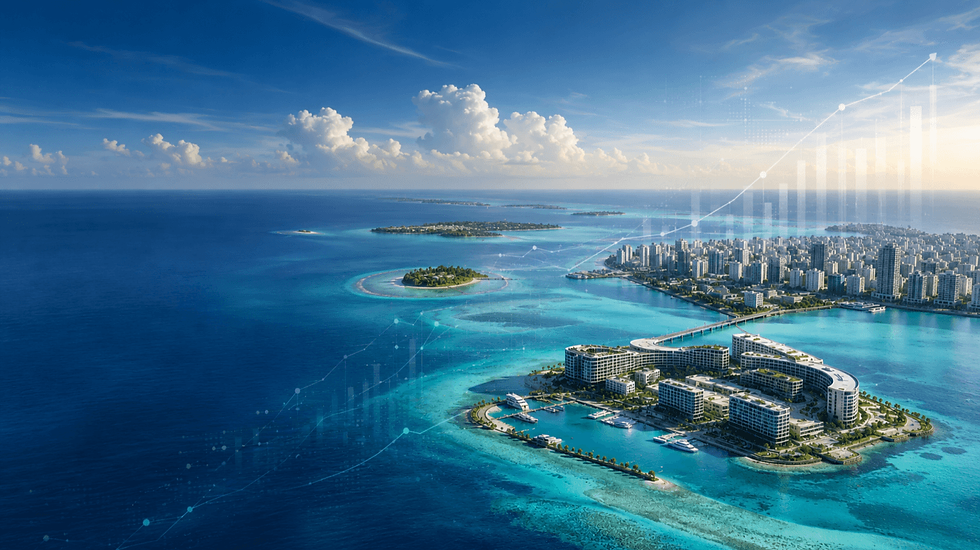
For many years, the investment conversation around the Maldives followed a familiar pattern.
The country was seen primarily through the lens of tourism. Investors looked at resorts, islands, hospitality assets, and the strength of the Maldives as one of the world’s most recognizable luxury destinations. That view was not wrong. Tourism built the global reputation of the Maldives, shaped its economic identity, and continues to remain one of its strongest pillars.
But markets do not remain still. The Maldives of today is not the same investment environment it was ten or fifteen years ago. The country is evolving. Its infrastructure is expanding, its urban center's are becoming more valuable, its population needs are changing, and its economic opportunities are no longer limited to traditional resort development. This raises an important question.
Has the investor mindset evolved with the market?
Because while many investors still look at the Maldives as a tourism destination, the country is gradually becoming something broader: a platform for capital, real estate, lifestyle, infrastructure, services, and long-term strategic positioning.
That shift matters.
The old investment question was simple: “Where is the island?”
The new investment question is different: “Where is the value being created?”
This is where the Maldives story becomes more interesting.
The next phase of growth will not only be about who owns the most beautiful asset. It will be about who understands how the market is changing, where demand is moving, and how opportunities can be structured properly for serious capital.
In many emerging markets, opportunity is often visible before it is fully organized. The Maldives is no different. There are landowners with valuable assets, businesses with growth potential, developers with strong concepts, and international investors looking for credible entry points. On paper, these parties should naturally connect.
In reality, the gap between opportunity and investment is often wider than it appears.
A project may look attractive, but it may not be investor-ready. A land parcel may have strong potential, but the ownership structure, approvals, commercial model, or documentation may not be clear enough. A local business may be capable of scaling, but it may not have the financial presentation, governance structure, or strategic positioning required to attract the right partner.
This is one of the most important realities of the Maldives investment market today. The issue is not always the absence of opportunity. Often, the issue is readiness. Serious investors are not only looking for beauty, location, or a promising idea. They are looking for clarity. They want to understand the legal pathway, the financial logic, the execution model, the risks, the returns, the operating environment, and the people behind the project.
Capital does not move only because something looks attractive. Capital moves when confidence is created. That confidence comes from structure.
This is where the Maldives must now compete at a higher level. The country is no longer being compared only within its own domestic market. Investors are comparing opportunities across regions. They are looking at Dubai, Saudi Arabia, Indonesia, Sri Lanka, Seychelles, Mauritius, and other destinations that are also positioning themselves for tourism, lifestyle, real estate, infrastructure, and private capital.
In that environment, the Maldives has a powerful advantage. It already has global recognition. It already has premium positioning. It already has scarcity, natural beauty, and a strong emotional brand.
But the next stage requires more than reputation.
It requires maturity in how opportunities are prepared, packaged, and communicated. This is especially important because the investment landscape itself is widening. The future of the Maldives will not only be shaped by resorts. It may also be shaped by urban real estate, branded residences, wellness hospitality, marine infrastructure, private aviation support, renewable energy, logistics, digital services, high-end destination management, and luxury lifestyle experiences.
These areas are not separate from the Maldives tourism story. In many ways, they are connected to it.
A stronger airport supports stronger tourism. Better urban development supports better quality of life. Marine services support both tourism and trade. Wellness and lifestyle hospitality expand the country’s value proposition. High-end concierge and destination services improve the experience of premium travelers and investors. The opportunity is no longer one-dimensional. It is becoming an ecosystem. And ecosystems require a different investment mindset.
An investor entering the Maldives today needs to ask deeper questions. Is the opportunity commercially realistic? Is the timing right? Is the local partner credible? Is the project aligned with the direction of the market? Is there real demand, or only speculation? Can the project be executed within the Maldivian operating environment? Can it compete regionally? Can it create long-term value?
These questions are not obstacles. They are necessary. They separate serious investment from surface-level interest.
For local asset owners and project holders, this shift is equally important. The market is becoming more selective. It is no longer enough to say, “We have land,” or “We are looking for an investor.” The stronger position is to present a clear, structured, credible opportunity that speaks the language of capital.
Investors need more than access. They need confidence. And confidence is built through preparation.
This is where the real transformation of the Maldives investment market may take place. The next wave of value may not only come from new assets, but from better structuring of existing ones. It may come from turning informal opportunities into investable propositions. It may come from connecting local knowledge with international capital. It may come from helping investors understand not just what is available, but what is actually executable.
In that sense, the Maldives is entering a more sophisticated chapter.
The country still has the natural advantage that made it famous. But the next generation of investors will be looking beyond beauty. They will be looking for clarity, credibility, and execution. The investors who understand this shift will have an advantage.
They will not only ask where the opportunity is. They will ask whether the opportunity is ready. They will not only look at what exists today. They will look at what the market is becoming. They will not only chase visibility. They will search for value before it becomes obvious to everyone else.
At Vast Ventures, this is the space we continue to study closely, the intersection between capital, opportunity, and execution in the Maldives. Because the Maldives investment story is changing.
The question is whether investors are changing with it. For those who still see the Maldives only as a tourism destination, the market may appear familiar. But for those who look deeper, a different picture is emerging.
The Maldives is becoming a more complex, more selective, and more valuable investment environment. And in this next chapter, the real opportunity will not simply belong to those who arrive early. It will belong to those who understand the market properly.
Comments